
Sportsbook Risk Management System

Founder & CEO
 12 min read
How a sportsbook risk management system works: liability and net position, pre-bet checks, exposure limits, margin control, sharp detection and FAQ.
Building a sportsbook risk module?
Talk to our team about liability tracking and bet acceptance before you build.
Spend a Saturday afternoon with a trading team and you notice something odd. Nobody is staring at the odds. They're watching the exposure screen, the one that says how much the book loses if the underdog scores late. Customers will forgive a price that lags a second or an app that looks a bit dated. Take too much money on the wrong side of a cup upset and there's no forgiving anything.
That screen is only as trustworthy as the risk module feeding it, and most of the problems we get called in to look at on sportsbook platforms start there.
The short answer: a sportsbook risk management system accepts or refuses every bet in real time, keeps a running figure of what the operator would lose on each result, and acts on its own when that figure drifts: it shortens a price, trims a stake or suspends a selection. It's also where you catch the accounts and bet patterns that slowly drain margin.
This is part two of our sportsbook architecture series. Part one covered odds feed integration, which gets a price onto the customer's screen. This one starts at the moment they tap "Place bet."
1. What a sportsbook risk management system is for
Vendors describe this in a lot of different ways. When I sketch it for a new client I end up with the same four jobs every time, and every one of them runs against the clock:
- decide whether to accept each bet, and for how much, before the customer gets bored of the spinner;
- keep exposure up to date per selection, market, event, sport and customer, through every acceptance, cash-out and settlement;
- step in when exposure goes past what the traders have agreed to, by repricing, cutting stakes or suspending;
- spot the patterns that cost money: arbitrage, correlated multiples, bonus farming.
It sits between the bet slip and the wallet, and it has to keep its head at exactly the moments when everything around it is busiest.
2. Betting liability management starts with the right number
For a single fixed-odds bet with stake S at decimal price d, liability is S × (d − 1), the winnings you'd pay on top of handing back the stake. Add that up across every bet on a selection and you have the selection's liability.
Liability alone can fool you, though. It ignores the money you keep from everyone who backed something else. What traders actually watch is the net position for each outcome: all the stakes taken on the market, minus the total you'd pay back (stakes plus winnings) if that outcome wins.
A simple football match-result market shows why the difference matters:
| Outcome | Stakes taken | Average price | Liability if it wins | Book result if it wins |
|---|---|---|---|---|
| Home | €10,000 | 2.10 | €11,000 | −€1,000 |
| Draw | €6,000 | 3.40 | €14,400 | −€400 |
| Away | €4,000 | 3.60 | €10,400 | +€5,600 |
| Total | €20,000 | — | — | Between −€1,000 and +€5,600 |
Those prices carry an overround of about 4.8% (1/2.10 + 1/3.40 + 1/3.60 ≈ 1.048). If the money had come in exactly in line with the prices, the book would keep roughly 4.6% of stakes whatever happened. It didn't. The draw has the biggest liability, but home is where the book loses most, and the only result that makes money is an away win. Looking at liability alone, you'd have protected the wrong outcome. That gap between the margin you priced and the position you actually hold is the whole reason the risk module exists.
Multiples make it messier. An accumulator's liability is its stake × (combined odds − 1), and it hangs over every leg until that leg settles. When the first two legs of a four-fold come in, the remaining exposure lands on the last two, often on a later kick-off. If your exposure model doesn't carry that contingent liability forward, a popular Saturday acca can be a very unpleasant surprise by the evening games.
3. What happens between "Place bet" and "Bet accepted"
Every bet goes through the same pipeline. The order is deliberate: cheap checks throw out bad offers before the expensive ones run.
- Validate the offer. Is the market still open? Is the price the customer saw still good? Most books accept a price that has moved in the customer's favour, or within a tolerance they've opted into, and bounce the rest back with the new price. Is the stake within the market limit, the customer's own limit and the maximum payout for the bet type?
- Project exposure. Work out what the bet does to the net position on its selection, and on every leg if it's a multiple, and compare that with the limits.
- Screen for abuse. Compare the price with your own fair price or a market reference, check correlation on multiples and same-game parlays, and look at how fast this account has been betting.
- Decide. Accept, reject, or send the bet to a trader with the reason attached, so they aren't starting from scratch at 9:40 on a Saturday night.
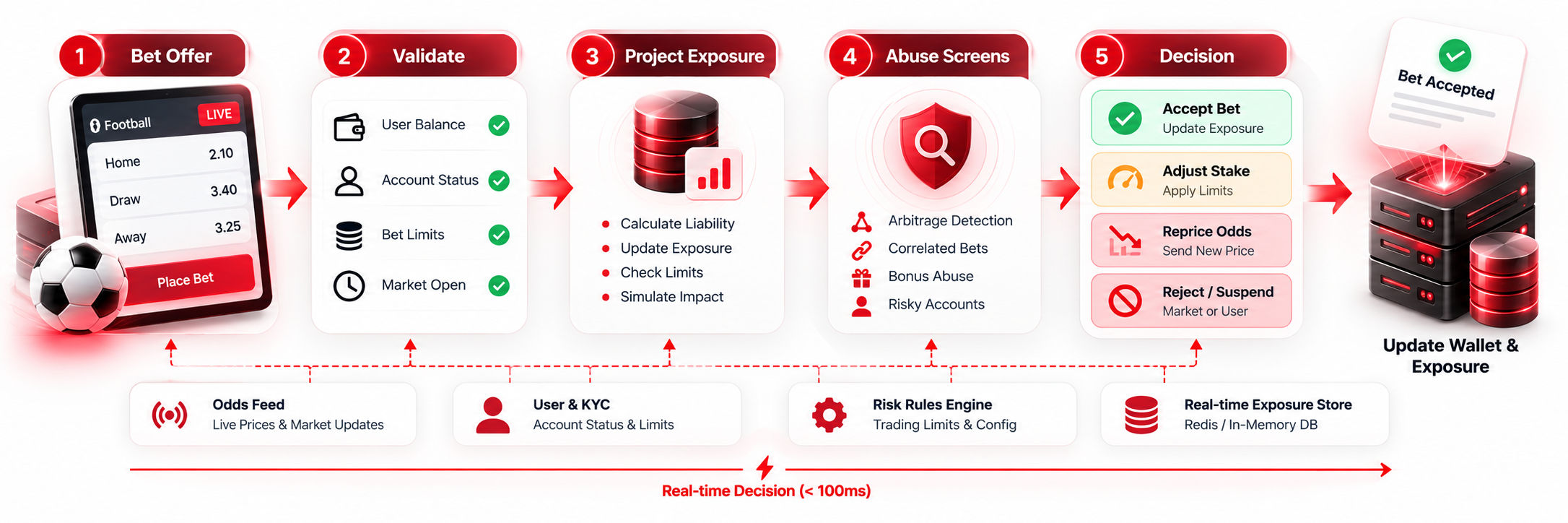
How fast does this need to be? The synchronous check should take tens of milliseconds, with the 99th percentile well under 100 ms, so placing a bet feels instant. In-play is its own animal. Most books hold in-play bets for a short acceptance delay, usually a few seconds, then run the checks again against whatever happened in that window: a goal, a card, a price move. That second check does far more to protect you from late bets than any amount of micro-optimising the first one.
4. Exposure limits on a betting platform: keeping the numbers right under load
Exposure has to be right at the instant a bet is accepted, and that includes the thirty seconds after a favourite concedes, when half your customers pile in at once. If two requests read the same figure, both pass the limit check and both get accepted, you've sold past your own limit without anyone noticing. Eventual consistency is fine for the reporting dashboard. It's not fine for this.
We keep live exposure in an in-memory store, deliberately separate from the odds cache so a burst of price updates can't slow down bet acceptance. The check and the reservation happen in one atomic step. In Redis that's a short Lua script. Money is held in integer cents so rounding can't creep in, and the limit is on the net position, the book's worst-case loss on a selection, not on raw liability:
-- KEYS[1] = exposure hash for one market (all amounts in integer cents)
-- ARGV[1] = selection id
-- ARGV[2] = stake of the new bet
-- ARGV[3] = total return if this selection wins (stake x price, rounded by the bet service)
-- ARGV[4] = the most the book may lose on this selection
local stakes = tonumber(redis.call('HGET', KEYS[1], 'stakes') or '0') + tonumber(ARGV[2])
local payout = tonumber(redis.call('HGET', KEYS[1], 'pay:' .. ARGV[1]) or '0') + tonumber(ARGV[3])
local loss = payout - stakes
if loss > tonumber(ARGV[4]) then
  return {0, loss}  -- over the limit: reject, reprice or refer
end
redis.call('HINCRBY', KEYS[1], 'stakes', ARGV[2])
redis.call('HINCRBY', KEYS[1], 'pay:' .. ARGV[1], ARGV[3])
return {1, loss}   -- reserved; loss is the new worst case on this selection
A few things this doesn't show but you'll need. The bet service works out the return (stake × price) in cents before it calls the script. Multiples reserve against every leg, which in practice means one script call across several markets, or a small reservation service in front of the store. And if anything downstream fails, say the wallet debit is declined, the reservation is released, so a failed bet doesn't leave phantom exposure hanging around.
One more thing, and it matters more than the script: the in-memory figure is never the source of truth. The bet ledger is. If the store is lost, or you suspect it's wrong, you rebuild exposure from open bets. Test that rebuild regularly. The first time you need it in anger is a bad time to find out it takes forty minutes.
5. Why the risk module listens to everything
The risk module needs to hear about three kinds of change, as they happen:
- normalized odds updates, because a price moved and today's exposure might not be acceptable at the new one;
- bet acceptances and cash-outs, because the position itself changed;
- match events, because a red card or an injury can mean related markets should suspend before the next price even arrives. It's the same kind of live event data that drives a scores product like our Scorex live sports app.
We run these as event-driven services on the same Kafka backbone the odds pipeline uses, so pre-match, in-play and cash-out decisions all see one ordered history. There's a nice side effect. If policies are versioned and decisions don't depend on the wall clock, replaying the stream after an incident reproduces what the risk module decided, not just what the prices were. That turns a lot of post-incident arguments into a quick look at the replay.
6. Book balancing: what the module does when exposure drifts
People in the industry call this book balancing, and there's plenty of software sold on that promise. Underneath, it comes down to a ladder of actions the module climbs as a selection's net position approaches its limit. Traders choose which rungs apply by sport and by how important the market is:
- nudge the price: shorten the exposed outcome a step, and usually lengthen the others a touch, so it's less tempting;
- add margin to the whole market, so every outcome pays slightly less;
- lower the maximum stake on that selection, for everyone or for particular customers;
- suspend the selection, and if that's not enough, the market.
This is where the sportsbook trading module and the risk module meet. Traders own the policy and can override any automated action. The module applies it, instantly and consistently, on every bet. Every automatic action should show up on the trader's screen, be reversible, and be logged with the exposure figure that triggered it. The whole point is to react faster than a person can at 3 a.m. It shouldn't make choices nobody can explain on Monday.
7. Sharp money, correlated parlays and bonus abuse
You can build a dozen screens here. In our experience three of them account for most of the money saved.
The first is sharp accounts. Winning is a weak signal, because anyone can have a good month. The stronger one is closing line value: does this account keep getting better prices than the final price just before kick-off? If it does over a few hundred bets, it's finding your slow prices, and a handful of accounts like that will find all of them. Most books respond with a per-customer stake factor, a multiplier on the normal limit. Do check what your regulator says about restricting accounts before leaning on this; some markets look at it closely.
The second is correlated bets. A same-game parlay with "player to score" and "over 3.5 goals" isn't two independent events. The legs tend to happen together, so multiplying the individual odds overpays. You either need a correlation model for the combinations you offer or a rule that blocks or reprices the ones you can't model.
The third is bonus abuse. Groups of accounts farming a welcome offer show up as patterns in velocity, devices and payment methods around sign-up and first bet. That overlaps heavily with identity checks, which we cover in part four, on KYC and AML architecture.
If the same wallet also funds casino play, as it often does, these screens need to see both sides. Crash games are the extreme case: rounds last seconds, so the risk rule becomes a cap on the total the operator can pay out in a single round rather than a per-market limit. Our crash game development service and the Lahore operator crash game case study go into that. Crypto books add one more wrinkle, because deposits arrive from wallet addresses instead of cards, which changes how multi-accounting shows up; that's part of our crypto casino and sportsbook development work.
8. The four stores you'll wish you'd built on day one
Four stores cover nearly everything. Each one earns its place the first time a regulator, an auditor or a very unhappy customer asks you a question:
| Store | What it holds | Why you'll need it |
|---|---|---|
| Market exposure | Stakes and returns per selection, including contingent liability from multiples | Every accept or reject decision reads it |
| Customer exposure and profile | Rolling exposure per account, stake factor, closing line value history | Stops one account concentrating risk |
| Decision log | Every accept, reject and referral, with reason codes and the exposure at that moment | Disputes, audits, and working out later where margin leaks |
| Policy store | Limits, stake caps and action ladders per sport and market, with full change history | Traders can change behaviour without a deploy |
If a team is going to cut a corner, it's usually the decision log, and it's usually regretted. Audits are only half of it. The log is also the dataset that shows which markets and which customer groups are costing you money, and that's how a risk module keeps getting better after launch instead of slowly going stale.
Regulators can shape these rules directly, too. Germany, for example, allows in-play betting on only a narrow set of markets, so the policy store for a German licence looks quite different from one for Malta. Our GGL-ready German casino platform case study and the Germany sportsbook development page cover what that means in practice.
Where this leaves you
Nobody thanks the risk module on a good weekend, which is roughly how you know it's working. Get the net position maths right, keep exposure correct under load, pair fast pre-bet checks with a proper in-play delay, and give traders a policy ladder they trust. Most of the difference between a book that trades calmly and one that's always a step behind its sharpest customers lives in those four things.
Once a bet is accepted, it has to be paid out correctly, and only once. That's the subject of part three, on bet settlement engine design.
On a white-label platform, the risk engine usually belongs to the vendor while the configuration is yours to own and tune; our white-label iGaming platform case study is a useful reference for that split. And if you're still pricing up the whole build, our guide to building an online casino platform in 2026 breaks down the costs.
If you're building or rebuilding this on your own platform, risk management module development is a core part of our sportsbook development company work, from the exposure model through to the trader tools. We're happy to look at what you run today and tell you plainly where it's exposed.
Frequently asked questions
What is a sportsbook risk management system?
It's the part of a sportsbook platform that decides, bet by bet, whether to accept a wager and for how much, while keeping track of what the operator would lose on every possible result. It enforces loss limits, reprices or cuts stakes when exposure drifts, and flags accounts and bet patterns that cost the book money.
What is liability in sports betting?
Liability is the winnings the operator pays out if a particular outcome happens. For a single bet it's the stake multiplied by the decimal odds minus one. Traders care more about the net position per outcome: every stake taken on the market, minus everything paid back if that outcome wins.
How do sportsbooks limit risk automatically?
With a ladder of actions set per market: shorten the exposed price, add margin to the market, lower the maximum stake (often per customer through a stake factor), suspend the selection, and finally suspend the whole market. The risk module triggers these from live exposure at bet acceptance and from match events in-play.
What is the difference between a sportsbook trading module and a risk module?
The trading module is where people set prices and market strategy. The risk module enforces the limits automatically, on every bet. They share exposure data and policy settings, but the risk module should run as its own service so a problem in the trading tools never switches off protection.
How fast does a bet risk check need to be?
The synchronous check should take tens of milliseconds, with the 99th percentile well under 100 ms, so placing a bet feels instant. In-play bets are usually also held for a short acceptance delay of a few seconds and checked again against anything that happened in that time.
How do sportsbooks spot sharp bettors?
The most dependable signal is closing line value: whether an account consistently gets better prices than the final price just before the event starts. Doing that over a few hundred bets says far more than a winning streak, which can be luck.
Related Services from Betadrix
At Betadrix, we specialize in delivering enterprise-grade solutions. Explore our related services to see how we can assist with your technology goals: Best Blockchain Development Company | Betadrix, Casino & Sportsbook Software Development Company in Germany, Casino Game Development Services | Betadrix, Casino, Sportsbook & Gaming Software Development Company in Spain, Casino & Sportsbook Development Services in Finland, Casino Sportsbook Development Services | Betadrix, Custom Crash Game Development | Aviator-Style Platforms | Betadrix, Casino & Sportsbook Development Services in Austria | Betadrix, Casino & Sportsbook Software Development Company in Canada, B2B Casino, Sportsbook & Blockchain iGaming Platform Development in Brazil, Crypto Casino Software Development Company | Betadrix.
Want a review of your exposure design?
We assess pre-bet decision paths, exposure stores and book-balancing rules for live platforms.
Sportsbook Risk Management System: How to Architect Liability, Exposure and Margin Control – sections
What a sportsbook risk management system is for
Betting liability management starts with the right number
What happens between "Place bet" and "Bet accepted"
Exposure limits on a betting platform: keeping the numbers right under load
Why the risk module listens to everything
Book balancing: what the module does when exposure drifts
Sharp money, correlated parlays and bonus abuse
The four stores you'll wish you'd built on day one
Ready to build your sportsbook risk management system?
Get a scoped plan covering odds, risk, settlement and KYC/AML.
Related Services
Series Guide
iGaming & Casino Gaming
Explore Categories
Browse More Technical Topics & Industry Guides
?Frequently Asked Questions
What is a sportsbook risk management system?
What is liability in sports betting?
How do sportsbooks limit risk automatically?
What is the difference between a sportsbook trading module and a risk module?
How fast does a bet risk check need to be?
How do sportsbooks spot sharp bettors?
Shivam Swami
Founder & CEOShivam Swami is the Founder & CEO of Betadrix, leading technical architecture and engineering. He specializes in distributed systems, real-time betting architectures, and high-concurrency iGaming platforms.
Build Your Custom Project
Connect with technical architects for scope and estimation.
More Articles in iGaming & Casino Gaming



Related services built to solve your specific challenges


Watch.
Learn.
Grow.
Discover how our engineered solutions transform industries and propel client operations forward.


Slot Aggregator Platform Case Study: Designed So a Player Is Never Charged Twice | Betadrix
READ CASE STUDYTechnologies & Frameworks Powering This Service


Hire Specialized Developers For Your Service Project

Python Developers
Pre-vetted senior Python Developers ready to deploy into your existing architecture in 3-7 days.
React Developers
Pre-vetted senior React Developers ready to deploy into your existing architecture in 3-7 days.

Nodejs Developers
Pre-vetted senior Nodejs Developers ready to deploy into your existing architecture in 3-7 days.

Flutter Developers
Pre-vetted senior Flutter Developers ready to deploy into your existing architecture in 3-7 days.
What Our Clients Say
“Mobile app development and cloud migration were handled smoothly. Strong technical skills, clear communication, and dependable post-launch support stood out throughout the engagement.”

Sarah Mitchell
Director of Operations, HealthFirst Clinics
Have a Project in Mind?
Let's Build It Together.
Connect directly with our senior software architects and technical leads. We evaluate your requirements and deliver an actionable technical proposal within 24 hours.
Strict NDA Protection
Your intellectual property and technical specs remain 100% confidential.
24-Hour Response Guarantee
Guaranteed evaluation and scoping reply from an engineering manager.
Zero Obligation Estimate
Get accurate cost breakdowns and tech stack recommendations free of charge.
Request Free Technical Consultation
Let's build something serious.
Diagnose your system architecture, budget ranges, and roadmap parameters with an expert.
Scoping Diagnostic
Analyze your workflows in 60 seconds. A senior AI architect reviews every parameter personally.
 4.9/5.0 Partner
 4.8/5.0 Leader
 4.9/5.0 Rated
 4.8/5.0 Excellent
Not sure where AI actually moves the needle for you?
Answer a few brief questions. We will deliver a highly concrete scoping plan within 24 hours including:
- Recommendations on automation use-cases and MVP components
- Calculations on expected ROI and engineering timelines
- A structural roadmap to make your legacy stack AI-native