

Model Context Protocol Engineering: The Open Standard for AI Tooling
The Enterprise Challenge: The Limitations of Static LLMs and Human Bottlenecks
Basic LLM chats advise but fail to execute. Production workflows require agents capable of executing multi-step tasks, connecting to secure enterprise tools, maintaining context across sessions, and making autonomous decisions under strict policy controls.
Enterprise Solutions: Bridging Intelligence, Context & Autonomous Execution
Cognitive Steps
ReAct and Plan-and-Solve architectures for multi-step reasoning and dynamic tool selection.
MCP Integration
Model Context Protocol for secure API, database, and internal enterprise data access.
Structured Outputs
Strict JSON Schema validation and type enforcement for high-fidelity data pipelines.
Multi-Agent Orchestration
Hierarchical agent teams collaborating seamlessly with human-in-the-loop fallback controls.
Trusted by global enterprises
- 700+
- Projects Delivered
- 450+
- Clients Served
- 20+
- Countries
- 6+
- Years Experience
Protocol Architecture: JSON-RPC 2.0 & Dual Transport Layers
At its core, the Model Context Protocol is a stateful, bidirectional protocol operating on top of JSON-RPC 2.0. Communication follows a strict client-host-server hierarchy: the Host (the user application, such as Cursor or Claude Desktop) coordinates one or more Clients, which maintain 1:1 connections to isolated MCP Servers.
The protocol standardizes two distinct transport mechanisms tailored to different security and deployment boundaries:
- Standard Input/Output (stdio) Transport: Designed for local process isolation. The host spawns the MCP server as a local child sub-process, communicating via standard input (stdin) and standard output (stdout). Stdio offers zero network exposure, sub-millisecond IPC latency, and natural process lifecycle binding—ideal for developer tools, local CLI runners, and secure on-premise workstation agents.
- Server-Sent Events (SSE) over HTTP Transport: Built for distributed enterprise microservices and multi-tenant cloud backends deployed on cloud consulting architectures. The client establishes an HTTP POST channel for upstream JSON-RPC requests and opens a persistent SSE connection for downstream server-pushed notifications, streaming responses, and progress updates. This enables centralized cloud MCP clusters protected behind enterprise API gateways, corporate VPNs, and OAuth2/OIDC identity providers.
Upon connection, client and server execute an initial Capability Negotiation handshake (initialize method), declaring supported features (such as tool listing, resource subscriptions, logging levels, and prompt templating) before any functional payload is exchanged.
The Three Core MCP Primitives: Resources, Tools & Prompts
MCP models real-world capabilities into three strictly typed architectural primitives. Understanding the distinction between these primitives is critical to building clean, deterministic AI systems:
| Primitive | Core Function | Control Flow | Real-World Example |
|---|---|---|---|
| Resources | Passive, read-only context data identified by custom URIs | Application/User-driven: host fetches content and passes it directly into LLM context | postgres://analytics/schema/orders, git://repo/pull-requests/482/diff |
| Tools | Active, executable functions with side effects and input validation | Model-driven: LLM decides when to execute, outputs JSON arguments, inspects output | execute_sql_query, deploy_kubernetes_canary, refund_stripe_charge |
| Prompts | Server-managed, parameterized interaction templates and system instructions | User-initiated: guides the LLM through a specific multi-step operational workflow | debug_service_outage(incident_id), generate_contract_amendment(contract_id) |
Build Your Custom Project
Connect with technical architects for scope and estimation.
Production MCP Server Engineering: TypeScript & Python Implementations
While building a toy MCP script takes twenty lines of code, an enterprise-grade MCP server requires defensive type validation, structured error codes per JSON-RPC standards, concurrency handling, and rate limiting in Node.js/TypeScript and Python environments.
Betadrix develops MCP servers using official TypeScript (@modelcontextprotocol/sdk) and Python (mcp) SDKs. Key architectural standards in our servers include:
- Runtime Schema Validation with Zod & Pydantic: Every tool parameter definition is strictly typed. Input payloads that fail validation are rejected before touching underlying databases, with descriptive JSON-RPC
-32602 (Invalid params)errors returned to the LLM for self-correction. - Graceful Degradation & Timeouts: Long-running tool executions (such as running a build or querying a massive analytical warehouse) implement cancellation tokens and progress notifications (
notifications/progress), keeping the client informed without blocking event loops. - Stateful Cursor Pagination for Resources: Resources exposing large collections (such as thousands of database tables or log streams) utilize opaque cursor pagination, preventing memory exhaustion in both server and LLM context windows.
- Standardized Structured Error Handling: Differentiating between client protocol errors, tool execution failures, and authorization denials, preventing LLMs from misinterpreting a
403 Forbiddendatabase permission error as a hallucinated function failure.
Enterprise Security, Sandboxing & Prompt Injection Defense
Giving an LLM the capability to execute code, query production databases, and trigger cloud API actions creates a severe security attack surface. If an attacker injects malicious instructions through untrusted external data (indirect prompt injection), an unprotected agent might invoke a tool to delete records, exfiltrate API keys, or spin up unauthorized compute resources.
We build production MCP architectures with Defense-in-Depth Security Controls:
- Strict Human-in-the-Loop (HITL) Policy Enforcement: Destructive or sensitive tools (e.g. database updates, wire transfers, production deploys) require explicit cryptographic or interactive user confirmation before the server executes the action.
- Role-Based Access Control (RBAC): MCP servers validate client identity tokens (OAuth2/JWT) against corporate directory groups (Okta, Azure AD), dynamically filtering the list of tools and resources exposed to each specific user session in fintech banking architectures.
- Isolated Containerized Execution: Code execution and shell tools run inside ephemeral, micro-VM sandboxes (Firecracker, gVisor, or isolated Docker containers) with strictly blocked outbound networking and read-only host mounts.
- Output Sanitization & Exfiltration Guardrails: Sensitive fields (passwords, social security numbers, private keys) are redacted in-flight before tool responses are returned to the client LLM context.
Connecting MCP to Enterprise Systems & Microservices
The real power of MCP is realized when it interfaces directly with core enterprise infrastructure. Betadrix has delivered production MCP connectors for a diverse array of enterprise stacks:
- Transactional & Analytical Databases: Read-only and audited read-write MCP servers for PostgreSQL, MySQL, ClickHouse, and Snowflake with strict query AST parsing that blocks destructive DDL/DML unless explicitly permitted. Fast state caching is handled with Redis databases.
- Cloud & DevOps Infrastructure: MCP controllers for AWS, Kubernetes development, GitHub Actions, and ArgoCD, enabling engineering agents to query pod logs, inspect deployment health, and trigger rollbacks via natural language.
- Enterprise SaaS & Issue Trackers: Real-time bi-directional tools for Jira, Linear, ServiceNow, Salesforce, and Zendesk, enabling customer support and engineering automation bots to fetch tickets, update statuses, and draft resolution notes directly.
- Internal Enterprise Microservices: Automating the conversion of internal OpenAPI / Swagger documentation into fully compliant, validated MCP tool servers with zero manual schema duplication.
Multi-Agent Orchestration & Client-Side Ecosystem Integration
MCP is not limited to single-user desktop assistants; it is the foundational connective tissue for Autonomous Multi-Agent Systems. In complex multi-agent architectures (such as LangGraph, AutoGen, or custom supervisor-worker topologies), agents act as both MCP clients and MCP servers.
For instance, a 'Lead Developer Agent' can delegate sub-tasks to a 'Database Agent' and a 'DevOps Agent', each exposing specialized toolkits through standard MCP interfaces. Because the protocol standardizes error reporting, tool discovery, and progress monitoring, agents coordinate cleanly across process boundaries without fragile custom message protocols. Learn how this operates in our autonomous AI agent development services.
Furthermore, because major developer environments—including Claude Desktop, Cursor, Zed, and Continue.dev—natively support MCP, tools built for your autonomous backend systems can be immediately reused by your human engineers inside their daily IDE workflows, doubling the ROI of your AI tooling investments.
Architectural Comparison: MCP vs. Alternative Tool-Calling Methods
How does Model Context Protocol compare against legacy approaches to external tool integration? Here is our side-by-side engineering evaluation:
| Feature / Metric | Model Context Protocol (MCP) | OpenAI Function Calling (Direct) | LangChain / LangGraph Tools |
|---|---|---|---|
| Ecosystem Standardization | Open, model-agnostic protocol supported across Anthropic, Cursor, Zed, open-source | Proprietary to OpenAI API contract; requires translation adapters for Claude or Llama | Tightly coupled to Python/TypeScript LangChain runtime; high dependency bloat |
| Process Architecture | Decoupled client-server via stdio or SSE; tool runs in isolated, independent process | In-process application code; tool executes inside the web server handling LLM response | In-process execution; failures in tool code crash the agent execution thread |
| Context Modeling | Three distinct primitives: Tools (actions), Resources (data), Prompts (workflows) | Single primitive: Functions (everything must be shoehorned into an executable function) | Tools and Retreivers; lack of protocol-level resource subscription primitives |
| Security Sandboxing | Native boundary; server can run inside isolated containers or remote networks | Must be custom engineered at the web application layer | Requires complex custom sandbox wrappers and process managers |
| Reusability | Write once; immediately usable by CLI, web agents, desktop IDEs, and backend bots | Restricted to codebases directly invoking OpenAI API client | Restricted to applications utilizing the specific LangChain library ecosystem |
Ready to standardize your enterprise AI agent toolchain? Speak with our MCP solutions architects.
Frequently Asked Questions
Transforming the everyday, for multiple industries, and scaling digital impact
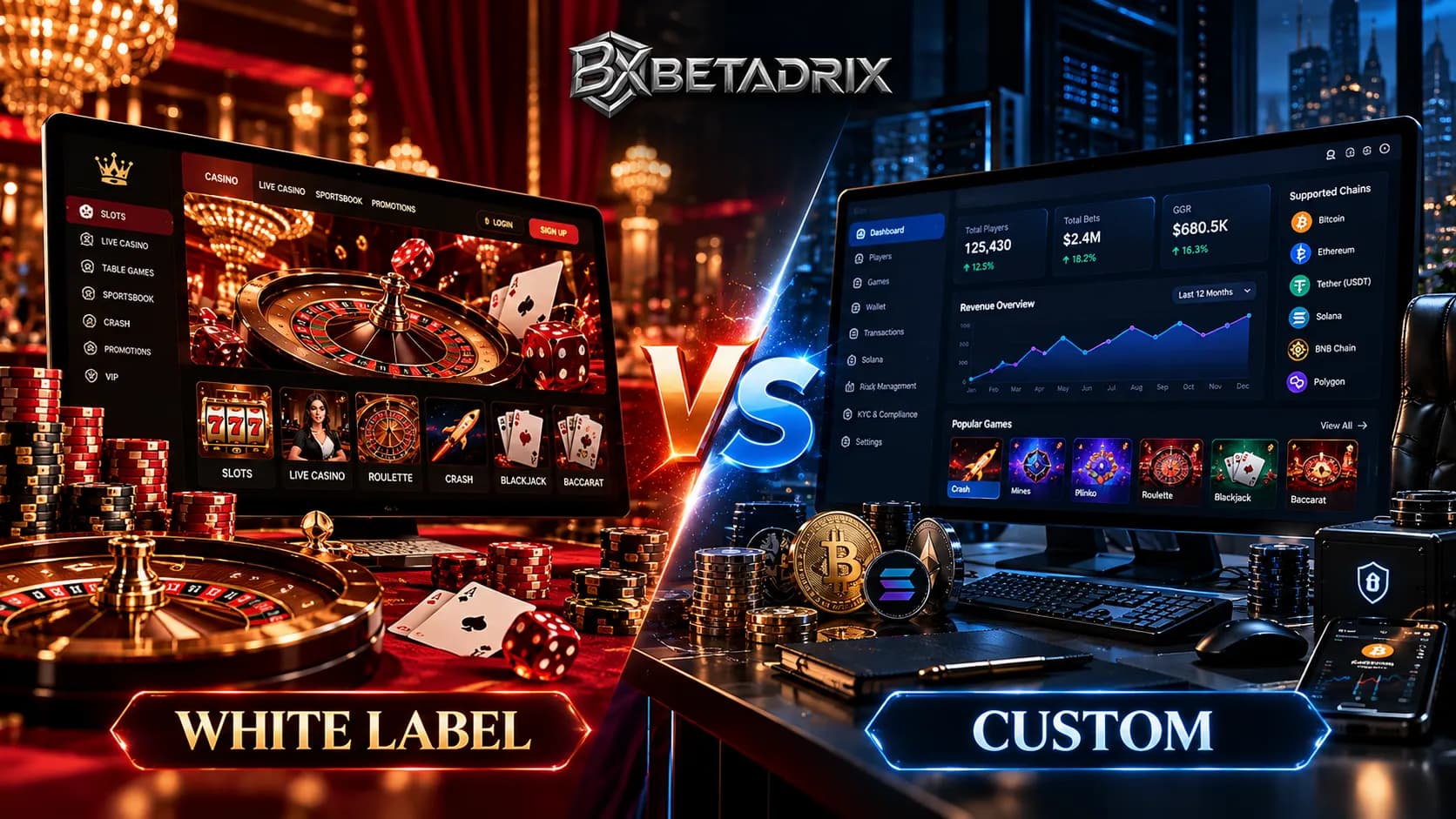
White Label vs Custom Crypto Casino: Which Model Should You Build?


Related services built to solve your specific challenges



Watch.
Learn.
Grow.
Discover how our engineered solutions transform industries and propel client operations forward.



Hire Specialized Developers For Your Service Project

React Developers
Pre-vetted senior React Developers ready to deploy into your existing architecture in 3-7 days.

Nodejs Developers
Pre-vetted senior Nodejs Developers ready to deploy into your existing architecture in 3-7 days.

Python Developers
Pre-vetted senior Python Developers ready to deploy into your existing architecture in 3-7 days.

Flutter Developers
Pre-vetted senior Flutter Developers ready to deploy into your existing architecture in 3-7 days.
Let's build something serious.
Diagnose your system architecture, budget ranges, and roadmap parameters with an expert.
Scoping Diagnostic
Analyze your workflows in 60 seconds. A senior AI architect reviews every parameter personally.
 4.9/5.0 Partner
 4.8/5.0 Leader
 4.9/5.0 Rated
 4.8/5.0 Excellent
Not sure where AI actually moves the needle for you?
Answer a few brief questions. We will deliver a highly concrete scoping plan within 24 hours including:
- Recommendations on automation use-cases and MVP components
- Calculations on expected ROI and engineering timelines
- A structural roadmap to make your legacy stack AI-native