
Sportsbook KYC Compliance: Architecture for Identity, Sanctions and

Founder & CEO
 12 min read
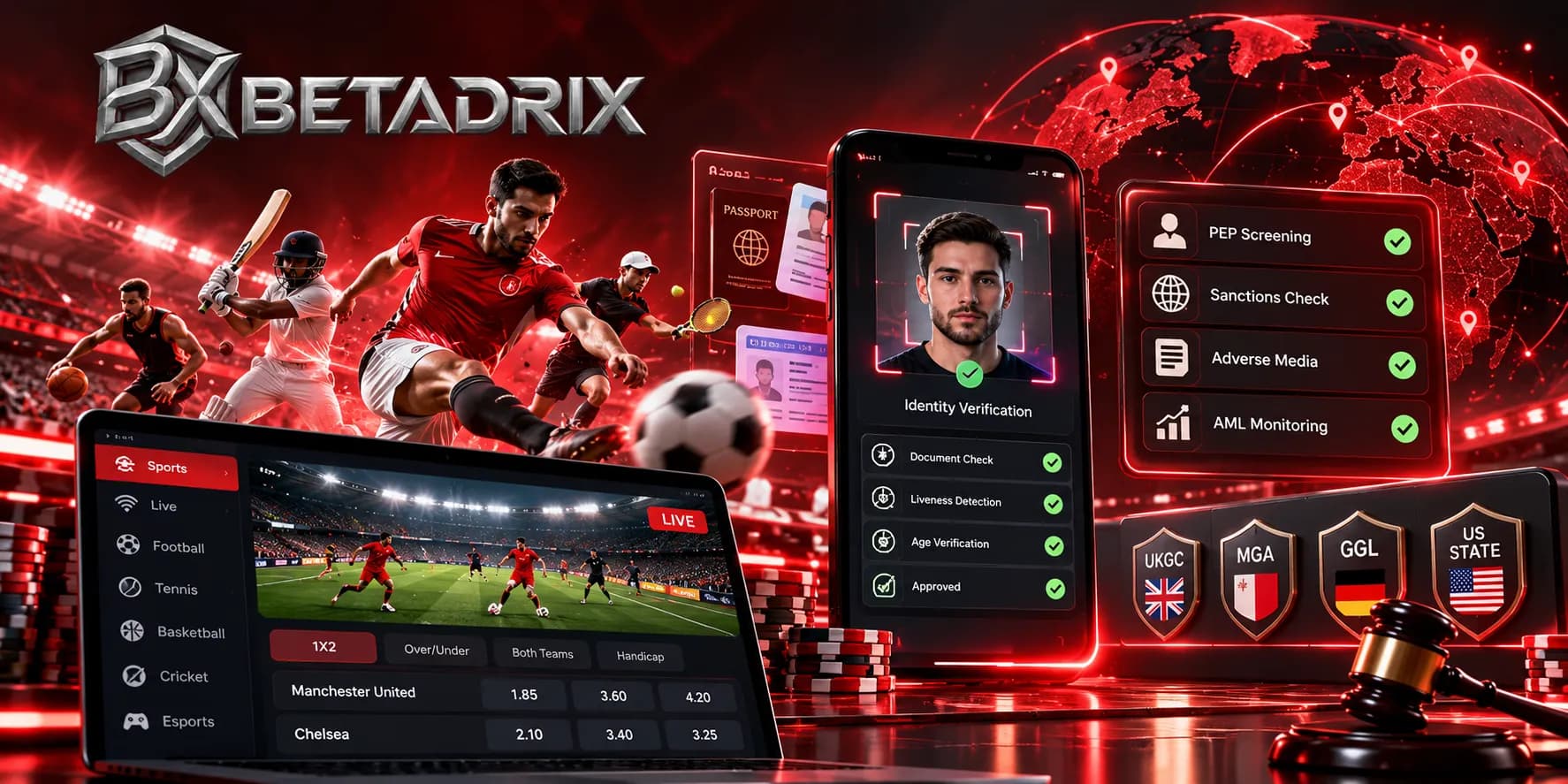
Build sportsbook KYC compliance into your platform: verification tiers, Sumsub integration, PEP and sanctions screening, AML monitoring and geolocation.
Launching a regulated sportsbook?
Talk to our team about verification, screening and monitoring before launch.
On most sportsbook builds, KYC gets designed in the last month before launch. It never features in a demo, the product team has been busy with the bet slip, and "we'll use a verification vendor" sounds like a plan. Then real customers arrive.
The version of this I remember best: compliance was a document-upload modal that appeared when someone pressed "Withdraw," and a compliance officer worked through the uploads from a shared spreadsheet. It held for about six weeks. After a big campaign, sign-ups tripled, the review queue stretched to four days, and complaints about withheld winnings reached the regulator before they reached us. We had to pause marketing spend and pull four senior backend engineers off the bet slip to build an emergency triage queue and retroactive webhook processor. Nobody on that team was careless. The design simply had no room for growth.
Quick version: sportsbook KYC compliance works best built into the platform. Each customer moves through verification tiers that are modelled explicitly. A vendor such as Sumsub handles document and face checks, while sanctions screening and transaction monitoring run for as long as the account is open. Personal data sits in its own locked-down store. All of it feeds the risk module, the wallet and the front end directly, so a rule is enforced in every place it applies.
This is the last post in our sportsbook architecture series, after odds feed integration, the risk management module and the bet settlement engine.
1. What regulators ask for, and why it shouldn't be hard-coded
Every licence has its own rulebook, yet the list of things you end up building looks much the same from one to the next: identity and age checks, self-exclusion checks, sanctions and PEP screening, a closer look at where high-value customers' money comes from, suspicious activity reporting, and in the US, proof that the customer is physically inside the state. What mostly changes is when each check has to happen.
| Licence | When identity must be verified | Other checks worth planning for |
|---|---|---|
| Great Britain (UK Gambling Commission) | Before the customer can deposit or gamble | GAMSTOP self-exclusion; financial risk checks at net-deposit thresholds |
| Germany (GGL) | At registration, before play | OASIS self-exclusion register; LUGAS cross-operator deposit-limit file |
| Malta (MGA) | Age checks early; full customer due diligence once deposits reach €2,000 | Verification before withdrawals; enhanced checks for higher-risk customers |
| US states | At account opening, before any wager | Geolocation inside state lines for every bet; minimum age of 21 in most states |
Treat that table as a starting point for a conversation with your compliance counsel, since these rules change and the detail matters. Whatever the details turn out to be, keep them in configuration per jurisdiction instead of in code. Teams that hard-code the first licence usually spend the second one untangling it.
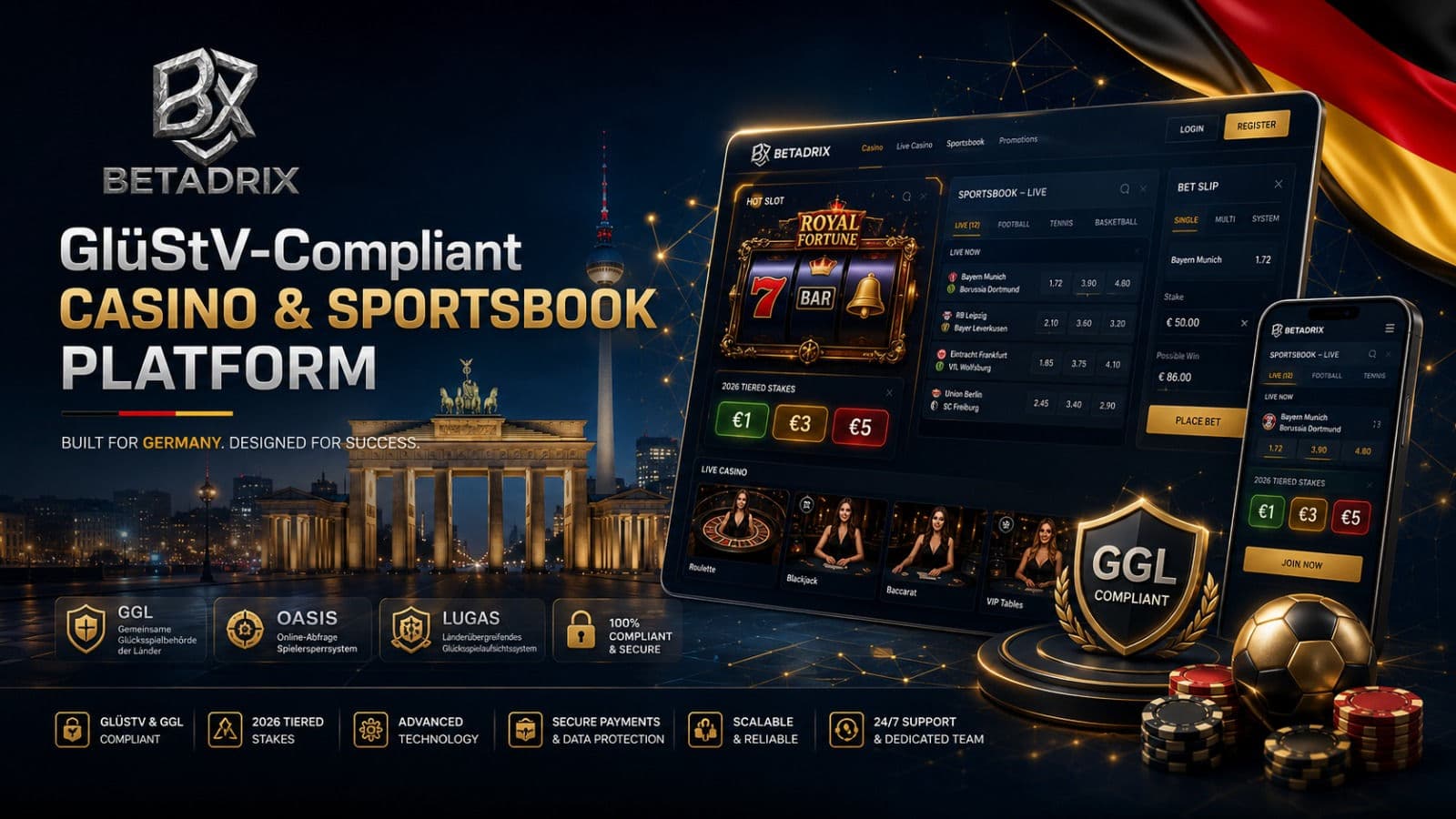
Our GGL-ready German casino platform case study is a good example of how much one regulator shapes a build, and our country pages for Germany, Spain, Brazil and Canada cover local requirements. For licence timelines with the MGA, Curaçao and the UKGC, see our guide to building an online casino platform in 2026.
2. Verification tiers: a state machine, not a checkbox
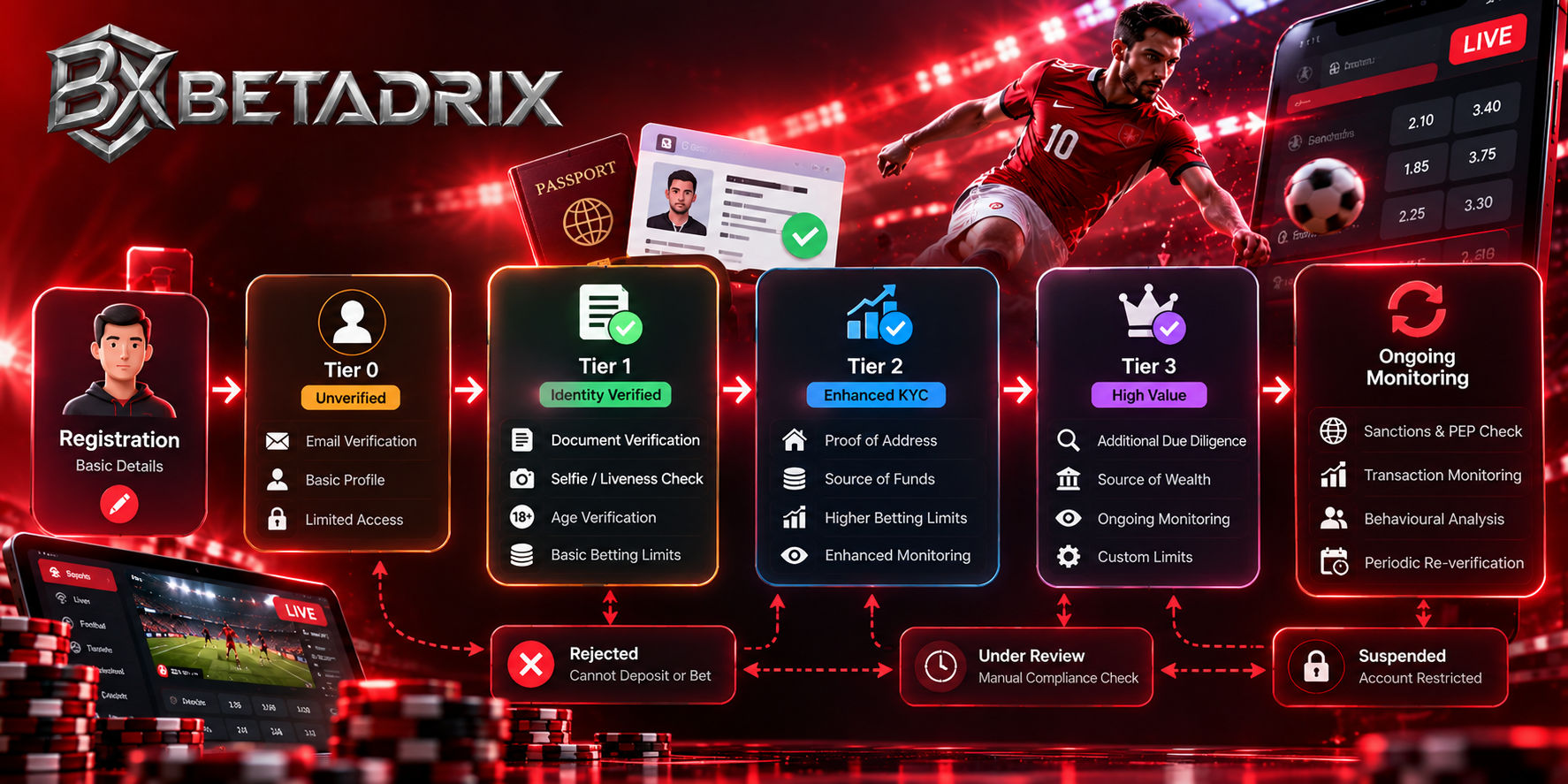
The most useful change I've seen teams make in this area is dropping the is_verified flag. A boolean can't say why someone isn't verified yet, what they may do in the meantime, or what they need to do next. An explicit state machine can answer all three.
Tier 0 is a registered customer. Their email or phone is confirmed, basic fraud and geo-IP checks have passed, and they've been checked against the relevant self-exclusion register (GAMSTOP in Great Britain, OASIS in Germany, and so on). Keep this step short. Every field you add here costs sign-ups, so ask only for what the licence needs at this point.
Tier 1 is verified: an identity document, a liveness or selfie check, proof of address where the licence asks for it, and sanctions and PEP screening. Depending on the licence, that happens before the first deposit or before the first withdrawal. Tier 2 is enhanced due diligence. It kicks in when deposits or losses cross thresholds you configure, or when someone is flagged as a PEP, and it means asking for evidence of source of funds or source of wealth.
Next to the tiers sit the restrictive states: pending review, restricted, self-excluded and closed. Self-exclusion normally runs for a period the customer chooses (six months, a year, five years), so give it an expiry date and model the steps the licence requires before someone can return. It also has to apply across every brand you operate, which goes wrong surprisingly easily when each brand grew up with its own customer table.
Each change of state is published as an event on the same Kafka backbone the rest of the platform uses. The front end reads it to show or hide the deposit and withdraw buttons, the risk module from part two uses it for stake limits, and marketing, finance and compliance all look at the same timeline. The question "is this customer verified?" finally gets one answer.
3. Sumsub integration and working with verification vendors
Very few operators should build document and face verification themselves. Keeping up with thousands of ID document formats and a steady stream of new fraud techniques is a whole business. Sumsub, Onfido (now part of Entrust), Veriff and Jumio are the names we see most often.
Crypto operators need one more check on top: screening deposit and withdrawal addresses with a blockchain analytics provider, so funds linked to sanctioned or illicit wallets are caught before they reach the account. We cover that as part of crypto casino software development.
How you wire the vendor in matters more than which one you choose. With Sumsub the flow usually goes like this. Your backend creates an applicant and issues a short-lived access token. The customer completes the checks in Sumsub's WebSDK or mobile SDK. The result then arrives at your server as a webhook, often seconds later and sometimes much longer if a document goes to Sumsub's own reviewers.
A few habits save a lot of pain with any vendor. Don't make the customer wait on a synchronous vendor call; take the result from the webhook. Verify the webhook's signature, and assume it will arrive more than once. Store what the vendor sends back (decision, extracted fields, reason codes, a reference to the images) as evidence, instead of calling the vendor again whenever someone asks. And run your own review queue with its own response-time target, because every vendor passes some documents to a human.
A Sumsub webhook handler that follows those habits looks roughly like this:
import crypto from "node:crypto";
import express from "express";

const app = express();

// Sumsub signs the raw request body with your webhook secret and tells you
// which algorithm it used. Check the header names and values against the
// current Sumsub docs before you ship this.
const ALGS = { HMAC_SHA1_HEX: "sha1", HMAC_SHA256_HEX: "sha256", HMAC_SHA512_HEX: "sha512" };

app.post("/webhooks/sumsub", express.raw({ type: "application/json" }), async (req, res) => {
  const alg = ALGS[req.get("x-payload-digest-alg")];
  if (!alg) return res.status(401).end();

  const expected = crypto
    .createHmac(alg, process.env.SUMSUB_WEBHOOK_SECRET)
    .update(req.body)                          // raw bytes, not re-serialised JSON
    .digest("hex");
  const received = req.get("x-payload-digest") ?? "";

  if (received.length !== expected.length ||
      !crypto.timingSafeEqual(Buffer.from(received), Buffer.from(expected))) {
    return res.status(401).end();
  }

  try {
    const event = JSON.parse(req.body.toString("utf8"));

    // Record the evidence and hand off. The tier change happens in a worker,
    // not in this request. Sumsub retries webhooks, so this insert ignores
    // an event it has already stored.
    await verificationEvents.insertIfAbsent(event);
    await queue.publish("kyc.vendor-result", event);
    res.status(200).end();
  } catch (err) {
    // A 5xx makes Sumsub retry later. Express 4 won't catch a rejected
    // promise for you, so without this the request just hangs.
    logger.error({ err }, "sumsub webhook failed");
    res.status(500).end();
  }
});
One more rule, and it's the one I'd put on a poster. If the vendor is slow or down, the customer goes into a queue with a clear message about what happens next. They are never waved through. The worst bug I've come across in this layer was a try/catch that unlocked withdrawals whenever the vendor call timed out, and it had been live for months before anyone spotted it.
4. PEP screening, sanctions and adverse media
Screening happens at sign-up and then keeps happening for as long as the account is open. The sources are the sanctions lists published by the UN, the EU, the UK and the US Treasury's OFAC, plus commercial databases of PEPs and adverse media.
Name matching has to be fuzzy, because names get transliterated, misspelled and shared by thousands of people. Match on name alone and your analysts drown in false positives. Match on name together with date of birth and nationality, and plan for the false positives that remain anyway. Each possible hit goes to an analyst, who confirms or clears it. Cleared names go on an allowlist, and that allowlist is audited too; sooner or later somebody will ask who decided a customer wasn't the sanctioned person with the same name.
Sanctions designations take effect straight away, so rescreen the full customer base whenever a list changes, and at least once a day. That depends on knowing which accounts, cards and wallets belong to the same person across all your brands. Identity resolution is dull work, and screening is only as reliable as it is.
5. Betting transaction monitoring
Betting transaction monitoring is a rules and analytics engine reading the wallet ledger's stream of deposits, bets, wins and withdrawals. What it looks for is well documented. Lots of deposits in a short time. Structuring, meaning repeated deposits just under the amount that would trigger document checks. Money that goes in and comes back out with hardly any betting in between. Stakes that don't square with the customer's stated job or income. And, for high-value accounts, behaviour that stands out against similar customers.
If casino and sportsbook share a wallet, monitoring has to see both. With a game aggregator in the mix, that can mean thousands of titles feeding one ledger; our slot aggregator case study puts 2,000+ games behind a single API.
An alert opens a case with a timeline and an analyst assigned. If it looks suspicious, a suspicious activity report is filed with the national financial intelligence unit, such as the UK Financial Intelligence Unit at the National Crime Agency, the FIAU in Malta or FinCEN in the US. Teams new to gambling often assume it goes to the gambling regulator. It doesn't.
Two design points get missed. First, alerting a customer that they're under investigation ("tipping off") is an offence in many countries, so nothing in the case system should fire an automated email or visibly change the customer's account in a way that gives the game away. Second, monitoring is only as accurate as the ledger it reads. A case built on a double-counted deposit is a waste of an analyst's day at best, which is why the settlement work in part three matters to compliance too. A few minutes of delay in this layer is perfectly acceptable; wrong numbers are what cause trouble.
6. Geolocation compliance
Where a licence depends on where the customer is physically standing, the location check decides whether a bet is legal at all. In the US every bet has to come from inside the licensed state. Most operators use a specialist provider for this, GeoComply being the best known, which combines device GPS, Wi-Fi, IP data and checks for faked locations.
Check location when a session starts, then again at intervals while the customer is betting, and more often when they're close to a state border. Cache the last good result for the session with a short expiry. Keep every check as evidence. In an audit, the record of where each bet was placed from is one of the first things a regulator asks for.
7. Where the personal data lives
Passport scans, selfies, addresses and bank statements make this the most sensitive data the company holds. We keep it in a separate service and data store, with field-level encryption on the most sensitive fields. Other systems reach it through an audited API with permissions tied to a purpose, so a marketing job can see that someone is a VIP but never their passport number. Every read of an identity document is logged, including reads by our own staff, and retention runs as scheduled jobs per jurisdiction.
Retention is where teams most often get stuck. Anti-money-laundering rules generally require identity and transaction records to be kept for a set period, commonly five years after the customer relationship ends under EU and UK rules. GDPR allows retention that the law requires, so a deletion request doesn't override it. In practice you restrict that data to compliance use until the period runs out, then delete it. Build the tooling for access and deletion requests from day one; adding it after the data has spread around the company is far harder.
8. Why compliance belongs inside the platform
Count the places this layer touches the rest of the sportsbook. The tier state machine sets risk limits. Transaction monitoring reads the settlement ledger. Screening can stop an account from opening, and geolocation decides whether a bet is allowed. A compliance portal added beside a finished platform has to be connected to each of those afterwards, and every one of those connections is somewhere a rule can slip through.
So we design the KYC and AML layer together with the wallet and risk systems from the start. In other words, we build a KYC/AML sportsbook platform from the ground up. The same approach carries over to casino products that share the wallet, which our casino game development work covers.
Wrapping up the series
Looking back over the four posts, a few ideas kept coming up: keep separate streams separate, have one source of truth, make every movement of money idempotent, and hold rules as configuration you can audit. Compliance is where a regulator checks all of those at once, and sportsbook KYC compliance is much easier to get right when it's planned in from the first sprint.
On a white-label platform, parts of this layer usually come from the vendor, and the questions in this post are worth asking them; our white-label iGaming platform case study is a useful reference. For a live sports product we've shipped, see the Scorex live sports app case study.
If you're preparing a regulated launch or adding a new jurisdiction, the KYC and AML layer is part of what our casino and sportsbook platform development team designs, alongside the wallet and risk systems it has to fit. Tell us which licences you're aiming for and we'll sketch out what the compliance layer needs to do for each one.
Frequently asked questions
When does a sportsbook have to verify a customer's identity?
It depends on the licence. In Great Britain, age and identity must be verified before a customer can deposit or gamble. Germany requires identification at registration, before play. US states verify at account opening, before any wager. Malta ties full customer due diligence to a €2,000 deposit threshold alongside earlier age checks. Build the rules as configuration per jurisdiction so one platform can serve several licences.
What is PEP screening in sports betting?
It's checking customers against lists of politically exposed persons, meaning senior public officials plus their family members and close associates, who carry a higher risk of bribery and corruption. Matches are found by fuzzy name matching plus date of birth and nationality, confirmed or cleared by a compliance analyst, and confirmed PEPs go through enhanced due diligence.
How does AML transaction monitoring work for a sportsbook?
Rules and anomaly models run over the wallet's transaction history, looking for things like high deposit velocity, repeated deposits just under a documentation threshold, deposits withdrawn with little betting in between, and play out of line with the customer's known profile. Alerts become cases for compliance analysts, and suspicious cases are reported to the national financial intelligence unit.
Should we build KYC in-house or use a vendor like Sumsub?
Use a vendor such as Sumsub, Onfido (now part of Entrust), Veriff or Jumio for document and biometric checks; keeping up with document types and fraud techniques is a full-time business. Build the parts that tie into your platform yourself: the verification tier state machine, screening adjudication, transaction monitoring and the PII store.
Can a customer ask a sportsbook to delete their KYC data?
They can ask, but anti-money-laundering law usually requires the operator to keep identity and transaction records for a set period, commonly five years after the relationship ends under EU and UK rules. GDPR allows that retention. The data should be restricted to compliance use during that period and deleted when it ends.
Who receives a sportsbook's suspicious activity reports?
They go to the national financial intelligence unit, not the gambling regulator: for example the UK Financial Intelligence Unit at the National Crime Agency, the FIAU in Malta, or FinCEN in the United States. Staff must not tell the customer a report has been made.
Related Services from Betadrix
At Betadrix, we specialize in delivering enterprise-grade solutions. Explore our related services to see how we can assist with your technology goals: Casino & Sportsbook Software Development Company in Germany, Casino Game Development Services | Betadrix, Casino, Sportsbook & Gaming Software Development Company in Spain, Casino & Sportsbook Development Services in Finland, Casino Sportsbook Development Services | Betadrix, Custom Crash Game Development | Aviator-Style Platforms | Betadrix, Casino & Sportsbook Development Services in Austria | Betadrix, Casino & Sportsbook Software Development Company in Canada, B2B Casino, Sportsbook & Blockchain iGaming Platform Development in Brazil, Crypto Casino Software Development Company | Betadrix.
Need a review of your KYC and AML design?
We assess verification tiers, vendor integration and transaction monitoring for live platforms.
Sportsbook KYC Compliance: Architecture for Identity, Sanctions and AML Monitoring – sections
What regulators ask for, and why it shouldn't be hard-coded
Verification tiers: a state machine, not a checkbox
Sumsub integration and working with verification vendors
PEP screening, sanctions and adverse media
Betting transaction monitoring
Geolocation compliance
Where the personal data lives
Why compliance belongs inside the platform
Ready to build a compliance-ready sportsbook?
Get a scoped plan covering odds, risk, settlement and KYC/AML.
Related Services
Series Guide
iGaming & Casino Gaming
Explore Categories
Browse More Technical Topics & Industry Guides
?Frequently Asked Questions
When does a sportsbook have to verify a customer's identity?
What is PEP screening in sports betting?
How does AML transaction monitoring work for a sportsbook?
Should we build KYC in-house or use a vendor like Sumsub?
Can a customer ask a sportsbook to delete their KYC data?
Who receives a sportsbook's suspicious activity reports?
Shivam Swami
Founder & CEOShivam Swami is the Founder & CEO of Betadrix, leading technical architecture and engineering. He specializes in distributed systems, real-time betting architectures, and high-concurrency iGaming platforms.
Build Your Custom Project
Connect with technical architects for scope and estimation.
More Articles in iGaming & Casino Gaming






Related services built to solve your specific challenges


Watch.
Learn.
Grow.
Discover how our engineered solutions transform industries and propel client operations forward.


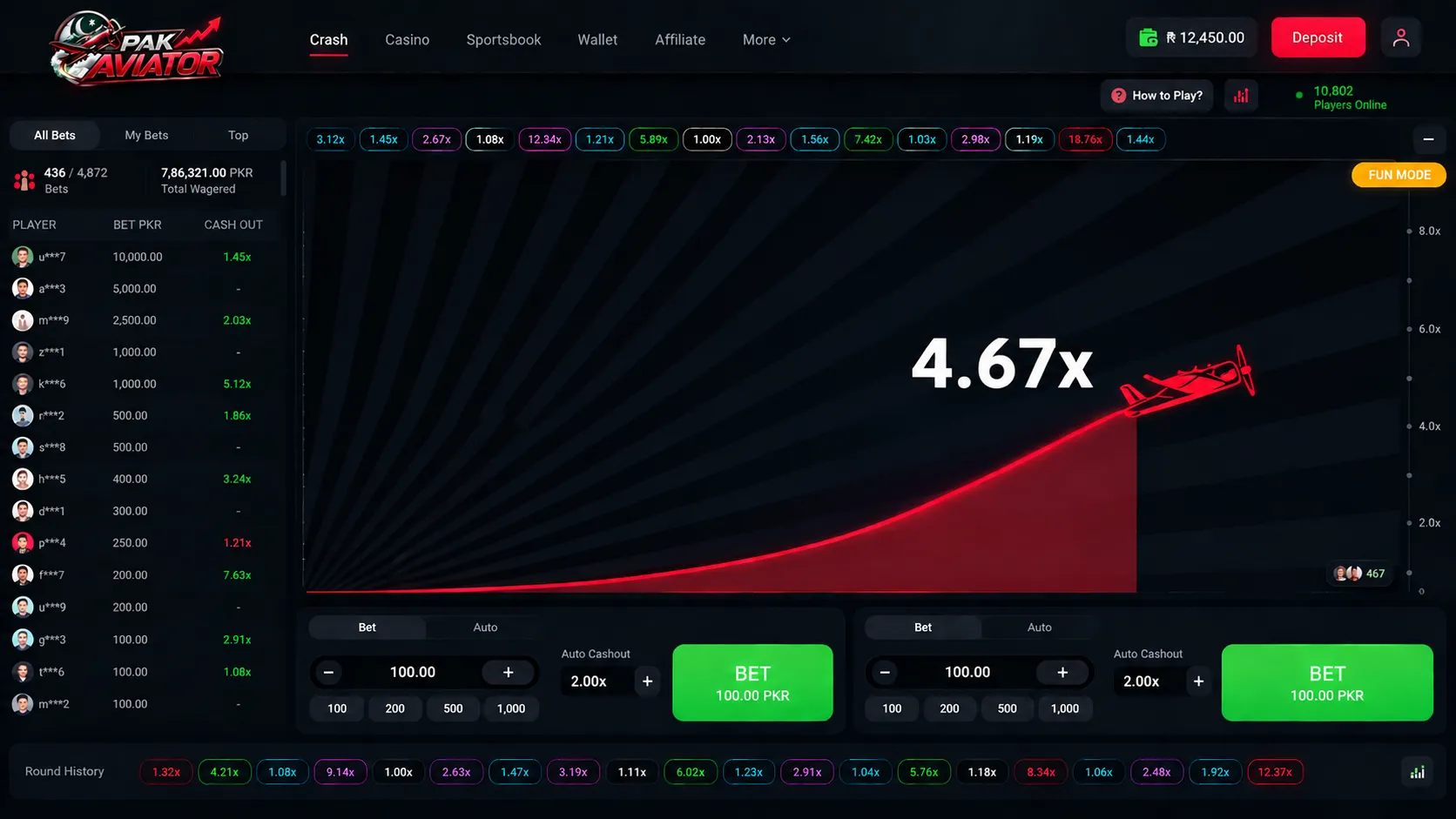
Owning the Game, Not Renting It: Custom Crash Game Development for a Lahore-Based iGaming Operator
READ CASE STUDYTechnologies & Frameworks Powering This Service

Node.js Development Services | High-Concurrency Event-Driven Architecture | Betadrix
backend

.NET Development Services | Enterprise C# & ASP.NET Core Engineering | Betadrix
backend


Hire Specialized Developers For Your Service Project

Python Developers
Pre-vetted senior Python Developers ready to deploy into your existing architecture in 3-7 days.

Flutter Developers
Pre-vetted senior Flutter Developers ready to deploy into your existing architecture in 3-7 days.

Nodejs Developers
Pre-vetted senior Nodejs Developers ready to deploy into your existing architecture in 3-7 days.
React Developers
Pre-vetted senior React Developers ready to deploy into your existing architecture in 3-7 days.
What Our Clients Say
“Mobile app development and cloud migration were handled smoothly. Strong technical skills, clear communication, and dependable post-launch support stood out throughout the engagement.”

Sarah Mitchell
Director of Operations, HealthFirst Clinics
Have a Project in Mind?
Let's Build It Together.
Connect directly with our senior software architects and technical leads. We evaluate your requirements and deliver an actionable technical proposal within 24 hours.
Strict NDA Protection
Your intellectual property and technical specs remain 100% confidential.
24-Hour Response Guarantee
Guaranteed evaluation and scoping reply from an engineering manager.
Zero Obligation Estimate
Get accurate cost breakdowns and tech stack recommendations free of charge.
Request Free Technical Consultation
Let's build something serious.
Diagnose your system architecture, budget ranges, and roadmap parameters with an expert.
Scoping Diagnostic
Analyze your workflows in 60 seconds. A senior AI architect reviews every parameter personally.
 4.9/5.0 Partner
 4.8/5.0 Leader
 4.9/5.0 Rated
 4.8/5.0 Excellent
Not sure where AI actually moves the needle for you?
Answer a few brief questions. We will deliver a highly concrete scoping plan within 24 hours including:
- Recommendations on automation use-cases and MVP components
- Calculations on expected ROI and engineering timelines
- A structural roadmap to make your legacy stack AI-native