
Owning the Game, Not Renting It
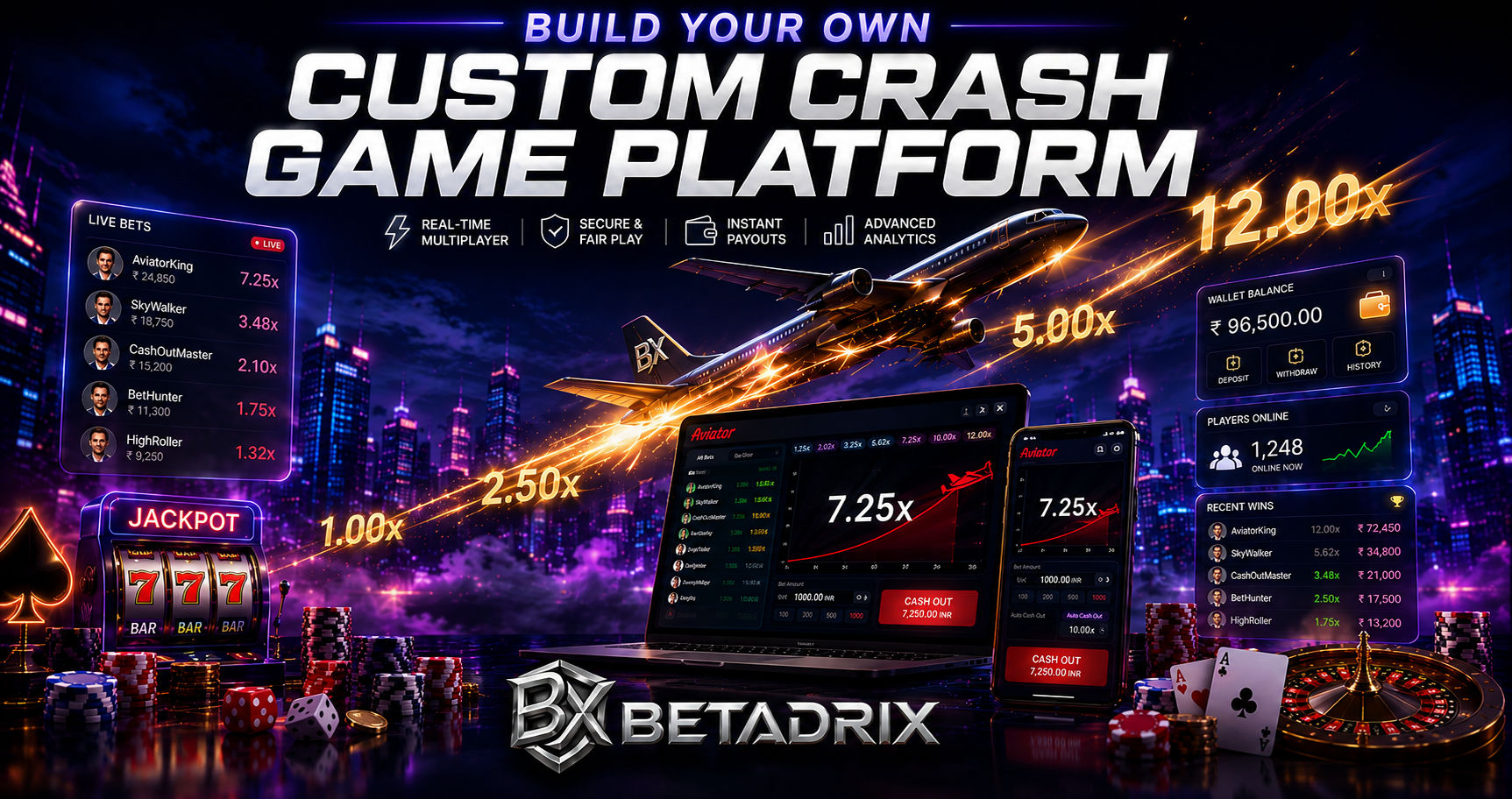
"Owning our crash game engine instead of leasing white-label changed our business entirely. We have full control over wallet transactions, settlement disputes dropped by 90%, and we run on local payment rails without vendor dependencies."
How We Actually Approached It
We didn't start with the game screen — that's usually where these projects go wrong, building the fun part first and retrofitting security and settlement logic onto something never designed to hold it. Instead we spent the early sessions walking through failure scenarios: a server restart mid-round, a player's wifi cutting out on cash-out, two requests hitting the wallet at the same instant. Once that list existed, the architecture wrote itself — settlement engine and wallet ledger first, treated as the actual product; the game rendering came after, as a layer that displays whatever the backend has already decided is true. That's what building a genuinely server-authoritative crash game requires: a backend that's willing to be the only source of truth, with the frontend demoted to a display layer. The same discipline carries across the sportsbook and casino integration work we do more broadly as a crash game development company — see our sportsbook development and casino game development services for the same settlement-first approach applied to other game types.
The same settlement logic is already exposed as a REST + WebSocket crash game API that the admin panel consumes — the same interfaces that would allow this engine to be plugged into a sportsbook or mobile client later. That specific integration hasn't been built or tested for this project, so it's a statement about the architecture's shape, not a delivered feature.
What Players Actually See and Use
A live HTML5 Canvas experience — multiplier climbing on an exponential curve, a plane following a rendered flight path, round history down the side. Players can run two independent betting decks, each with its own stake and auto-cashout target. Manual cash-out, auto-bet, pre-flight cancellation — all real, none of it deciding anything on its own; it's reporting what the server already knows. Cash-out runs through a fixed backend sequence every time: lock the bet, confirm it's still active, confirm the round hasn't already crashed, calculate the payout off server time (never the client's clock), mark it settled, credit the wallet, log it, commit.
Money, Integrity, and the Admin Side
Money is stored as integer paise, not floats. Every balance change writes its own ledger entry — who, what, when, tied back to the bet or round. The crash point for any round can be independently recalculated after the fact, since the seed is committed before betting opens and revealed after settlement. The admin panel gives full analytics — betting volume, GGR, margin against expected margin, rolling weekly/monthly windows — plus player search and history, deposit/withdrawal handling via JazzCash and bank transfer, adjustable risk controls (min/max bet, exposure caps, house edge), and an audit log on every setting change.
What Happens When Things Go Sideways
Server restarts mid-round cancel the round and refund eligible bets automatically. A disconnected player's auto-cashout keeps working regardless of whether their browser is open. Duplicate cash-out attempts are caught by idempotency checks before they ever touch the wallet. None of this shows up in a demo — all of it shows up the first time something actually breaks.
What the Client Actually Received
This was custom crash game development in the fullest sense of the phrase — full ownership of the game engine, not a license to run someone else's. Hamza walked away holding full casino source code with IP rights: nothing borrowed, nothing that reverts to a vendor if the relationship ends. In practice that means his own settlement engine and wallet ledger running on infrastructure he controls, and risk parameters — house edge, min/max bet, exposure caps — that are a setting in his own admin panel rather than a request sitting in someone else's support queue.
What This Platform Doesn't Do (Yet)
To be direct about scope: this build runs on JazzCash and bank transfer only. There's no crypto payment rail and no blockchain component in the current architecture, and this write-up isn't claiming otherwise. If Hamza — or another operator evaluating a similar build — needs blockchain-based or crypto casino support, that's genuinely future-phase work: a real multi-currency wallet in place of the current single-currency ledger, and crypto rails added alongside JazzCash and bank transfer, which is a legal question in most markets at least as much as a technical one. It isn't built, it isn't running, and it doesn't belong in the results above — it's just the honest next step if the business case for it shows up.
Frequently Asked Questions
Recognized & Verified By Top Global Platforms
Project Details
- Client
- Hamza Bilal (Akbar)
- Industry
- iGaming — Online Casino & Sportsbook
- Technology Stack
- Node.jsExpressTypeScriptReactPostgreSQLWebSocketsHTML5 CanvasHMAC SHA-256REST APIJazzCash
- Key Result
- 90%
- Settlement Dispute Reduction
Scope Your Project
Connect with our technical architects to get a complete scope of work and execution plan.
- Strict NDA Protected
- Free Technical Estimate
- Direct Architect Call
Related Cases
Ready to build high-performance infrastructure?
Our senior technical architects analyze your requirements, design real-time data flows, and build a production-ready execution roadmap.
- Tailored System Architecture
- Performance & Security Audit
- Clear Production Roadmap
Let's build something serious.
Diagnose your system architecture, budget ranges, and roadmap parameters with an expert.
Scoping Diagnostic
Analyze your workflows in 60 seconds. A senior AI architect reviews every parameter personally.
 4.9/5.0 Partner
 4.8/5.0 Leader
 4.9/5.0 Rated
 4.8/5.0 Excellent
Not sure where AI actually moves the needle for you?
Answer a few brief questions. We will deliver a highly concrete scoping plan within 24 hours including:
- Recommendations on automation use-cases and MVP components
- Calculations on expected ROI and engineering timelines
- A structural roadmap to make your legacy stack AI-native