
From Five Games to a Full White-Label Gaming Operation
"The platform gave us exactly the flexibility we needed — start with a focused set of games and keep the infrastructure ready for more titles, providers and integrations as we grow."
It Started With Five Games
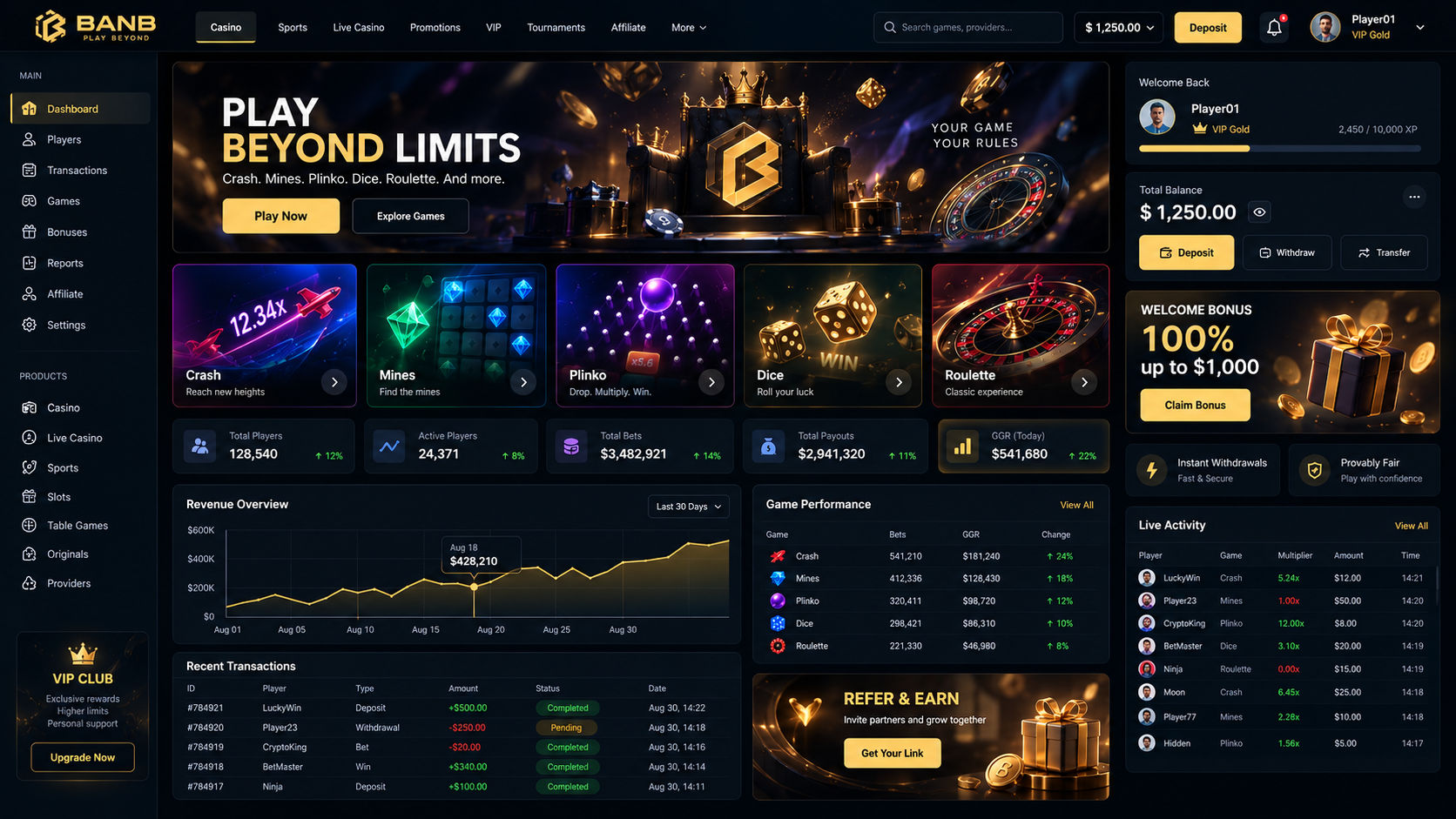
The first catalogue was deliberately tight. Crash — a real-time multiplier game built through our crash game development pipeline (see a related build in our crash game case study). Mines — a grid game where clarity matters more than decoration. Plinko — the falling ball and configurable risk levels. Dice — wager, probability, result. Roulette — a classic wheel-and-table experience. Each keeps its own visual identity while sharing the same design language, so a player always knows they’re still inside the same brand.
The Layer Players Never See
Most of the real work happened behind the games — linking every bet to the right player, keeping the wallet perfectly in sync, recording results accurately, and feeding the admin and reporting layers without gaps. We separated the gaming layer from the rest of the platform so new titles can be added later without touching the wallet, account system or admin tools.
Operator Panel Built for Answers
Satoshi needed a place to actually run the business. We built a dedicated operator environment covering players, transactions, games, betting activity, KYC status, revenue and GGR reporting, branding controls and permission management — built for speed and clarity, not decoration.
Reseller Layer for Multi-Brand Growth
In a white-label model the person running the brand is often different from the person managing the infrastructure. We added a separate reseller layer for brand and domain setup, game selection, player and transaction visibility, revenue reporting and account management — so the same platform can serve a single operator or support multiple brands on one foundation.
The Wallet Sits at the Centre
The wallet isn’t just another account page — it touches almost every action: deposit, gameplay, result, withdrawal. Where jurisdiction and payment providers allow, the platform also supports cryptocurrency and blockchain-based integrations, including supported assets, transaction tracking and wallet connectivity.
Third-Party Games and Room to Grow
Satoshi was never limited to games we built ourselves. The architecture supports third-party game and API integrations alongside our own casino game catalogue, so external content sits inside the same branded experience. The in-house side is structured to expand from the original five titles toward 20+ experiences — Aviator-style Crash, Keno, Poker, Teen Patti and more — without changing the core player flow.
Compliance and Responsible Gaming
The platform integrates third-party KYC/AML services for verification and screening, and includes responsible-gaming tools such as deposit and betting limits, session controls, self-exclusion and account restrictions. Licensing depends on the operating model and target jurisdiction — we supply the technology, and the licensing structure is discussed during onboarding so operators can choose what fits their plans.
Frequently Asked Questions
Recognized & Verified By Top Global Platforms
Project Details
- Client
- Satoshi
- Industry
- iGaming / Online Gaming
- Timeline
- 7 weeks
- Technology Stack
- Next.jsReact.jsTypeScriptNode.jsREST APIsWebSocketsMySQLSupabaseCrypto PaymentsKYC/AML API
- Key Result
- 5 to 20+
- Games Scalability
Scope Your Project
Connect with our technical architects to get a complete scope of work and execution plan.
- Strict NDA Protected
- Free Technical Estimate
- Direct Architect Call
Related Cases
Ready to build high-performance infrastructure?
Our senior technical architects analyze your requirements, design real-time data flows, and build a production-ready execution roadmap.
- Tailored System Architecture
- Performance & Security Audit
- Clear Production Roadmap
Let's build something serious.
Diagnose your system architecture, budget ranges, and roadmap parameters with an expert.
Scoping Diagnostic
Analyze your workflows in 60 seconds. A senior AI architect reviews every parameter personally.
 4.9/5.0 Partner
 4.8/5.0 Leader
 4.9/5.0 Rated
 4.8/5.0 Excellent
Not sure where AI actually moves the needle for you?
Answer a few brief questions. We will deliver a highly concrete scoping plan within 24 hours including:
- Recommendations on automation use-cases and MVP components
- Calculations on expected ROI and engineering timelines
- A structural roadmap to make your legacy stack AI-native